Nate Clintoff
The Drover's WifeNate Clintoff is the newly arrived sergeant in Everton, an officer whose promise of a quiet life in the Snowy Mountains gives way to murder investigations, colonial policing, and the case of Molly Johnson. His trajectory turns on a widening gap between the authority he is sworn to exercise and the human consequences he comes to recognize: he tries to protect vulnerable people, yet ultimately participates in a legal process that sends Molly to her death.
Identity and arrival
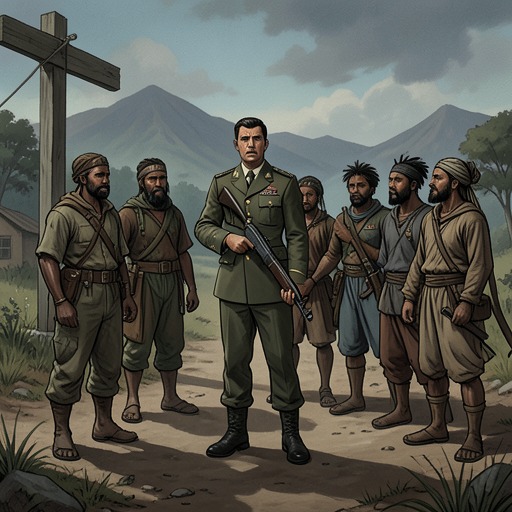
Nate arrives in Australia expecting the mountain country to be a safe place for his family. The position had been presented as a light-duty posting in picturesque surroundings, with quiet winters and the prospect of raising a family. Instead, he finds himself presiding over the aftermath of the murders of Ulla Edwards and her three children. Standing among their coffins, he is shocked that such a crime has occurred in what he had imagined as a sleepy, peaceful district.
The assignment also leaves him poorly equipped to investigate. Nate has no local official support beyond Trooper Spencer Leslie, whose physical skills have been judged inadequate and who has been assigned desk work. Reinforcements will take days to arrive. The contrast between the reassuring account of the job and the reality of a multiple-murder investigation makes Nate’s uncertainty part of his introduction: he has authority, but little practical support or experience of the violence facing him.
Nate’s personal hopes are bound to his wife, Louisa, and their young son. He had imagined a secure home where Louisa could write for her women’s journal and their child could play freely. Looking at Ulla’s body, he imagines what the loss would mean for his own family. His response to the murder is therefore not only professional alarm; it is sharpened by the recognition that the dead woman’s place in a family could have been Louisa’s.
Investigating the murders
As the inquiry develops, Nate receives a telegram reporting that a trooper and a Native Policeman were found dead three weeks earlier, north of the Victorian border, while moving an Aboriginal prisoner. A tracker has identified the prisoner as the killer and reported that he was wounded in the lower back. Nate connects this information to the wanted man believed to be sheltering in the mountains and asks why he would return there. The report expands the Edwards case into a larger pursuit, while also showing how official accounts frame the Aboriginal suspect as a threat before Nate knows the full circumstances of his flight.
Nate is not wholly persuaded by the assumptions surrounding the case. When the proposed reinforcements are discussed, he considers how they might pass through the Johnson property and notes the mountain routes used by Aboriginal people. Spencer says Molly will be checked on, but that the patrol cannot reach her for two days, and suggests that responsibility for her welfare would then be over. Nate hopes her husband will be home by then. His concern identifies Molly as isolated and vulnerable, although it remains entangled with the investigation’s search for a wanted man.
At the Edwards funeral, Nate quietly tells Spencer that he is worried about Mrs Joe Johnson, who is alone and in a delicate condition. The exchange exposes a contrast between his concern and local male attitudes: when Father McGuinness dismisses the idea that mountain women are delicate, the men laugh. Nate’s intervention does not remove Molly from danger, but it marks his early recognition that the town’s casual confidence in women’s toughness can conceal their exposure to harm.
Law, race, and the Johnson children
Nate’s encounters with Molly take place against an openly violent racial order. The wounded Aboriginal man hiding with her tells her that his only crime is existing while Black. Molly understands the implication from what she has witnessed: Aboriginal people are blamed, arrested, imprisoned, or driven away, while white people have unofficial permission to shoot them on sight. The disclosure gives Nate’s search for the suspect a context beyond the immediate murder inquiry. The fugitive is pursued under a system in which racial identity itself places him in danger.
The danger extends to Molly’s children. Miss Shirley calls them “Octaroon” and appeals to Judge Eisenmangher for help; the judge signs an authorization for their removal in the name of their safety. Danny hears the label and later repeats it to Molly, asking what it means. Molly remembers hearing Miss Shirley use a related racial classification when Molly was a child, in a conversation about sending her away. She recognizes that the same logic now threatens her own children. Nate is associated with the assumptions that make the children legible to officials as removable, even though the evidence does not show him signing the order.
When Molly reaches McGuinness’s residence, she binds Miss Shirley and Father McGuinness, takes supplies for the children, and burns the authorization. The paper’s language of classification, necessity, and permission is destroyed rather than obeyed. For Nate, the episode deepens the conflict between official order and the family’s immediate need to remain together: the state describes removal as protection, while Molly experiences the order as a threat to her children and acts to prevent their separation.
Suspicion, duty, and moral conflict
Nate’s concern for Molly eventually becomes suspicion. During an early-morning vigil, while Louisa is beside him and their sick son sleeps nearby, Nate recalls Molly’s description of Joe returning home happily. Louisa says the account did not ring true to her and that the children’s expressions had raised doubts. Nate then states that he thinks Molly killed her husband. He bases the suspicion on the smell near the woodheap, which recalls shallow graves and death he encountered during the war. His conclusion is not presented as certainty without evidence; it emerges from an observation, Louisa’s reading of Molly’s account, and the children’s reactions.
Nate later encounters Molly after she has killed John McPharlen. He sees her distress and the circumstances of her condition, but also sees the blood on her hands and the dying man. The sight makes the competing claims immediate: Molly has been subjected to violence, and she has committed a killing. Nate feels for her without being able to ignore what lies before him. This is the point at which compassion fails to provide an easy alternative to his oath.
While Molly is in custody, Nate admits to himself that he is troubled by his decision. He considers whether he should have turned a blind eye, understanding her act as the desperate response of a deeply wronged woman, but tells himself he took an oath to uphold the law and that another murderer remains at large. His uncertainty also strains his marriage. Louisa is fighting for legislation to help battered wives, but she knows it will not pass in time to help Molly. Nate recognizes both her commitment and the human cost of the delay.
Judgment and ending
Nate reflects on Molly’s trial as a process shaped by prejudice. The jury is all male; Miss Shirley declares Molly’s mixed heritage, and the prosecution argues that Molly’s hatred of white men is generational, rooted in what she learned about her ancestry and her mother’s suffering, and encouraged by the wanted Aboriginal man. Nate believes the hearing was biased, yet sees no way to change its course. Danny, the only witness to Molly’s truth, is missing. The absence of his testimony leaves the court’s account of Molly’s motives difficult to contest.
After Molly’s escape from custody, Nate asks where her children are and says he wants to help keep them safe. He has promised Louisa that he will do so, but his appeal comes alongside his guilt and his role in the legal system that has already failed Molly. Molly tells him that her children will have all the help and love they need; her confidence is expressed as hope, not as a guarantee Nate can secure. His wish to protect them therefore remains unresolved, dependent on a family whose whereabouts and future are uncertain.
At Molly’s execution, Nate struggles to carry out his duty. He cannot bear to look at her and turns his attention to Louisa, who does not turn away and silences her cries as the trooper steps forward. Nate gives the trooper a sharp nod. He has come to see the injustice and human damage surrounding Molly’s case, but he does not stop the execution. His ending is not a resolution of conscience: he performs the official act while remaining aware of what his oath has required him to do.
Narrative role
Nate provides a point of contact between Everton’s law enforcement and the private lives endangered by its racial and gender hierarchies. His role develops through a sequence of limits: he lacks investigative support, learns that the state’s protection can carry the threat of family separation, suspects Molly’s responsibility for a killing, and finally recognizes the bias of the proceeding without preventing its outcome. His concern is real, but it does not make his authority sufficient to rescue those he wishes to protect.
The narrative also makes the limits of his knowledge consequential. Nate can infer that Molly may have killed Joe from the circumstances around the woodheap and the children’s expressions, but he cannot supply Danny’s missing testimony at trial. He recognizes a racialized prosecution and a legal delay that leaves no time for Louisa’s proposed reform, yet remains bound to the institution that enforces the sentence. His character is thus defined less by a clean moral conversion than by the painful coexistence of sympathy, official responsibility, and complicity.